Pet urine on a wool rug and pet urine on a synthetic rug are two completely different problems — one is almost always fully fixable, and one often isn’t.
If you’ve ever wondered why the same “pet odor remover” spray works great on one rug in your house and does nothing on another, the fiber is usually the answer. Here’s the real difference, and why it changes what treatment actually works.
Quick answer: Wool is a protein fiber that reacts chemically with the ammonia and salts in urine, which is why odor and staining set in fast and deep — but a full-immersion flush-and-treat can usually fully resolve it. Synthetic fibers like nylon and polyester don’t chemically bond with urine, but their backing and padding can trap it, and once urine has saturated a synthetic rug’s foundation and pad, odor can become effectively permanent without full replacement of the affected layers.
Why wool reacts differently to urine
Wool is a protein fiber, chemically similar to human hair. Urine — which contains ammonia, uric acid, and salts — reacts with the protein structure of wool fairly quickly, which is why untreated pet accidents on wool can cause both staining and odor that seem to get worse over time rather than fading. The good news: because the reaction is chemical and localized to the fiber and foundation, a full flush-and-treat process that reaches the base of the pile can usually neutralize it completely.
Why synthetic rugs seem “easier” but aren’t always
Nylon, polyester, and olefin fibers don’t react chemically with urine the way wool does, and stains often wipe up more easily on the surface. But synthetic rugs are frequently backed with foam or latex, and if urine soaks through to that backing — or into a pad or the subfloor underneath — it can become trapped in a layer that’s much harder to reach and treat. That’s why synthetic rugs sometimes develop odor that returns after a surface cleaning: the source isn’t in the pile anymore, it’s underneath.
- Wool: chemical bonding in the fiber, but fully treatable with the right flush-and-neutralize process
- Synthetic: less fiber bonding, but higher risk of the source migrating into backing/padding where it’s harder to reach
Why odor gets worse with humidity
Uric acid crystals — the component of urine responsible for lingering odor — are not water-soluble once they’ve dried, which is part of why simple surface cleaning often fails to eliminate smell. Those crystals reabsorb moisture from humid air and “reactivate,” releasing odor again on humid days even in a rug that seemed odor-free when dry. That’s the science behind the common complaint that a rug “smells fine most days but gets musty when it’s humid” — in North Texas’ humid summer stretches, that reactivation cycle can repeat for years if the original contamination was never fully broken down and removed.
Why surface deodorizers usually don’t work
Most consumer pet-odor sprays are built to mask or lightly break down odor at the surface. They don’t reach the base of the pile or the backing, which is where urine actually settles once it’s had time to soak in. That’s why the smell often comes back — especially in humid weather, when trapped moisture reactivates the odor-causing crystals left behind by an incomplete cleaning.
Multiple pets, multiple layers of contamination
Homes with more than one pet, or a pet with a long-term habit of using the same spot, present a harder version of this problem: repeated saturation in the same area over months or years. Each round of urine that dries and gets walked on again drives contamination slightly deeper and slightly wider than the visible stain suggests. In these cases, a single treatment pass is often not enough — the affected area may need to be identified with a UV light (urine fluoresces under blacklight, which is how we map contamination that isn’t visible in normal light) and treated in layers, working from the deepest contamination outward.
What an actual fix looks like
- Full identification of how far the contamination has spread — pile, foundation, backing, or pad, often mapped with UV light
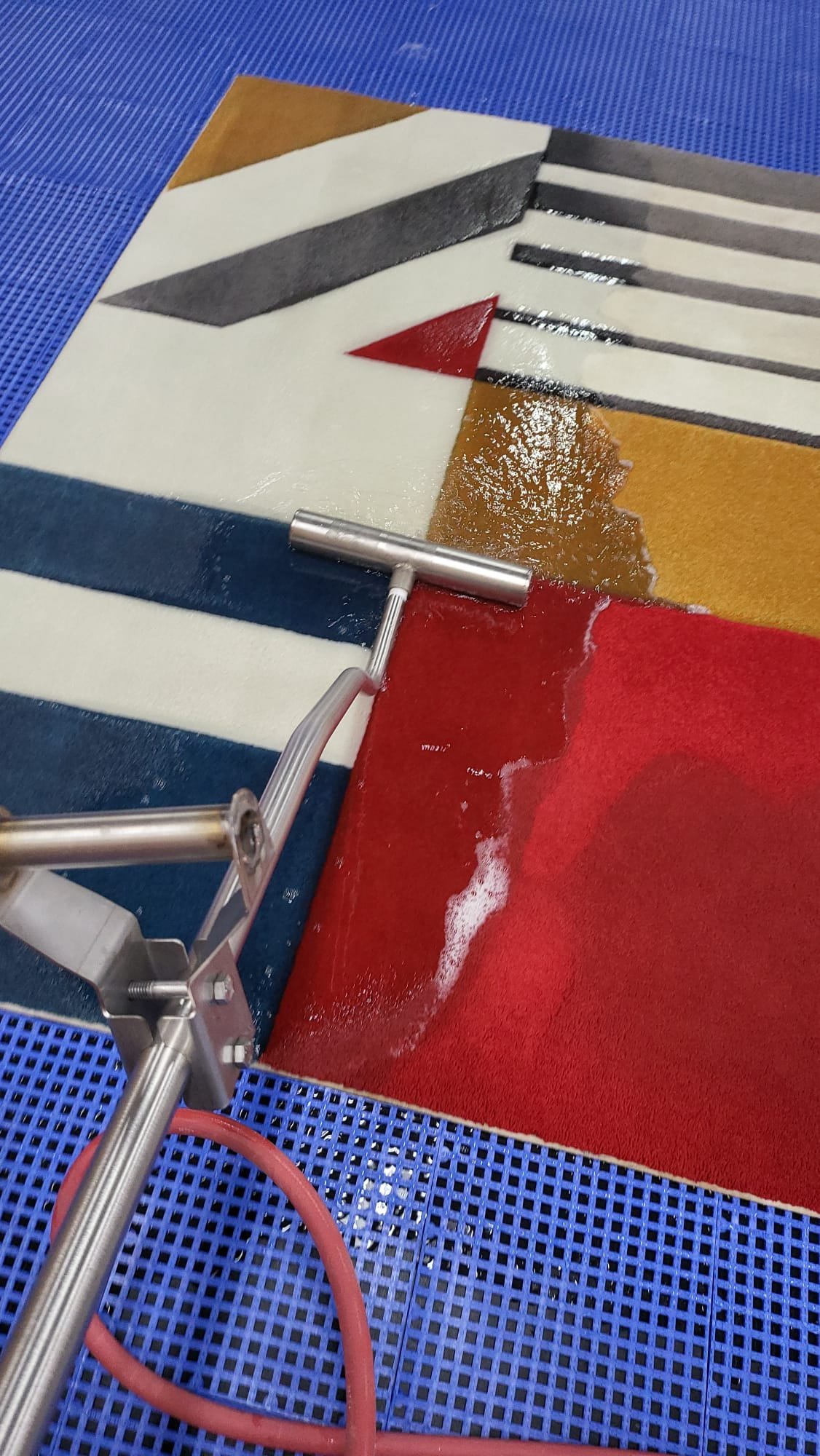
- A full-immersion flush that clears urine salts and residue from the fiber, not just the visible surface
- An enzymatic or antimicrobial treatment matched to the fiber type
- Controlled drying to prevent bacteria regrowth during the drying process
Tip: If a rug has been re-soiled in the same spot multiple times, treat urgently — repeated saturation makes it far more likely the contamination has reached the backing, where it’s much harder to fully resolve.
What happens to the pad and subfloor underneath
Contamination rarely stops at the rug itself. Once urine soaks through to a pad, the pad’s foam or rubber structure can absorb and hold odor-causing residue in a way that’s genuinely difficult to fully reverse — which is why heavily saturated pads are often more practical to replace than restore. If contamination has gone further, into a hardwood floor’s finish or the subfloor itself, that’s outside what rug cleaning can address and may need separate flooring treatment. Part of a thorough assessment is checking not just the rug, but what’s directly underneath it, since treating the rug alone while leaving a contaminated pad in place is a common reason odor seems to “come back” even after a genuinely effective rug treatment.
Preventing repeat accidents in the same spot
Pets are drawn back to areas where they’ve previously gone, partly because residual odor — even at levels too faint for humans to detect — signals “this is a bathroom spot” to an animal’s much more sensitive nose. That’s part of why full odor-source removal matters beyond just aesthetics: incomplete treatment can actually contribute to repeat accidents in the same area. Beyond a thorough professional treatment, consistent house-training reinforcement, and in some cases temporarily blocking access to the affected area until treatment is complete, are the most effective ways to break the cycle.
What makes enzymatic treatment different from a store-bought spray
Most consumer pet-odor products work by masking smell with fragrance or applying a surfactant that lifts some residue from the surface. Professional enzymatic treatment works differently — it introduces enzymes that specifically break down the uric acid crystals and protein compounds in urine at a molecular level, rather than covering or diluting them. That distinction matters because it’s the uric acid crystals themselves, not just surface residue, that reactivate and release odor when humidity rises. Breaking those crystals down chemically, rather than just cleaning around them, is why a proper enzymatic treatment paired with a full-immersion flush tends to permanently resolve odor that a surface spray only temporarily suppresses.
When professional testing is worth it even without a visible accident
Some households request urine testing on a rug even when no accident has been witnessed — often after moving into a home with an unknown rug history, or when a musty smell shows up with no obvious source. A UV inspection in these cases can confirm whether contamination is actually present before committing to a full treatment, which is useful both for peace of mind and for avoiding unnecessary treatment costs on a rug that turns out to be clean.
Frequently asked questions
Can old, dried pet stains still be treated?
Often yes, though older stains may need a more intensive flush-and-treat process, and severe or repeated staining on light-colored wool can leave some permanent discoloration even after odor is fully resolved.
Why does the smell come back after I clean it myself?
Surface cleaning typically doesn’t reach urine that’s settled into the base of the pile or backing — humidity or foot pressure can reactivate dried uric acid crystals from residue that was never fully removed.
Is pet urine treatment priced separately from regular cleaning?
Yes — it’s an add-on service since it requires extra steps beyond a standard wash, priced based on how extensive the contamination is.
Can a rug pad be treated too, or does it need replacing?
Lightly affected pads can sometimes be treated, but heavily saturated pads are usually more cost-effective to replace than fully restore.
How do you find urine spots that aren’t visible?
A UV blacklight makes urine residue fluoresce, which lets us map the true extent of contamination — often larger than what’s visible in normal light — before treatment begins.
Does the color of the rug affect how urine damage shows up?
Yes — lighter wool rugs show both staining and any resulting discoloration more visibly than darker rugs, though the underlying odor risk is the same regardless of color.
Can a treated rug still attract a pet back to the same spot?
If treatment was thorough, no — but incomplete treatment can leave trace odor an animal’s nose can still detect, which is one of the more common causes of repeat accidents in the same location.
Get a Free Quote → (469) 429-RUGS(7847)
Related: pet urine & odor removal · pet stain removal · deodorizing & sanitizing