
By the time you see an actual moth flying around your home, the damage to your rug has usually already started — moths don’t eat rugs, their larvae do, quietly, from underneath.
Rug moth damage is one of the most misunderstood rug problems, mostly because the visible signs show up well after the actual feeding has been happening. Here’s what to look for, and why speed matters once you spot it.
Quick answer: Look for irregular bare patches in the pile, fine webbing or sand-like debris (larval casings) in low-traffic areas or under furniture, and a rug that looks worse on the back than the front. Adult moths themselves don’t cause damage — their larvae feed on wool, silk, and other natural keratin fibers. Treatment needs to address both the visible damage and any eggs or larvae still present, or it comes back.
Early signs most people miss

- Bare, irregular patches in the pile — not the even wear of foot traffic, but random thin spots
- Fine, gritty debris or webbing that looks like sand or fine sawdust, usually along edges, under furniture, or in folds
- A musty, slightly sweet smell in stored or rarely-moved rugs
- Damage worse on the underside than the visible top of the rug, since larvae often feed from below
The moth life cycle — and why it matters for treatment
A clothes moth’s life cycle has four stages: egg, larva, pupa, and adult. Only the larval stage actually feeds on fiber — adult moths don’t eat rugs at all, they simply live long enough to mate and lay more eggs. A single female can lay 40 to 50 eggs in her lifetime, and depending on temperature and humidity, the full cycle from egg to adult can take anywhere from about six weeks to several months. That means by the time you spot an adult moth, there’s a real chance eggs or larvae are already established elsewhere on the same rug or nearby textiles — which is exactly why treating only the visible damage, without addressing the broader infestation, tends to fail.
Why moths target natural fibers specifically
Clothes moth larvae feed on keratin, the protein found in wool, silk, fur, and feathers — not synthetic fibers like nylon or polyester. That’s why moth damage almost always shows up on natural-fiber rugs, and why a wool Oriental rug in storage is at real risk while a synthetic rug in the same closet typically isn’t.
Where damage tends to start
Larvae prefer dark, undisturbed conditions — which is exactly why damage often starts under furniture, along baseboards, or in rugs kept in storage rather than in high-traffic walking areas. Regular foot traffic and light actually discourage moths, so a rug that’s rarely moved or a rug in a rarely-used room is at higher risk than one in a busy hallway.
Clothes moths vs. carpet beetles — a common mix-up
Carpet beetles are frequently mistaken for moth damage, since both feed on natural fibers and both prefer undisturbed areas. A few distinguishing signs: carpet beetle larvae are small, bristly, and oval-shaped rather than worm-like, and you’ll often find shed larval skins rather than the webbing associated with moths. The distinction matters because treatment for a beetle infestation follows a similar principle — full cleaning plus targeted treatment — but identifying the actual pest correctly helps confirm the infestation is fully addressed rather than assumed solved.
What actually stops an infestation
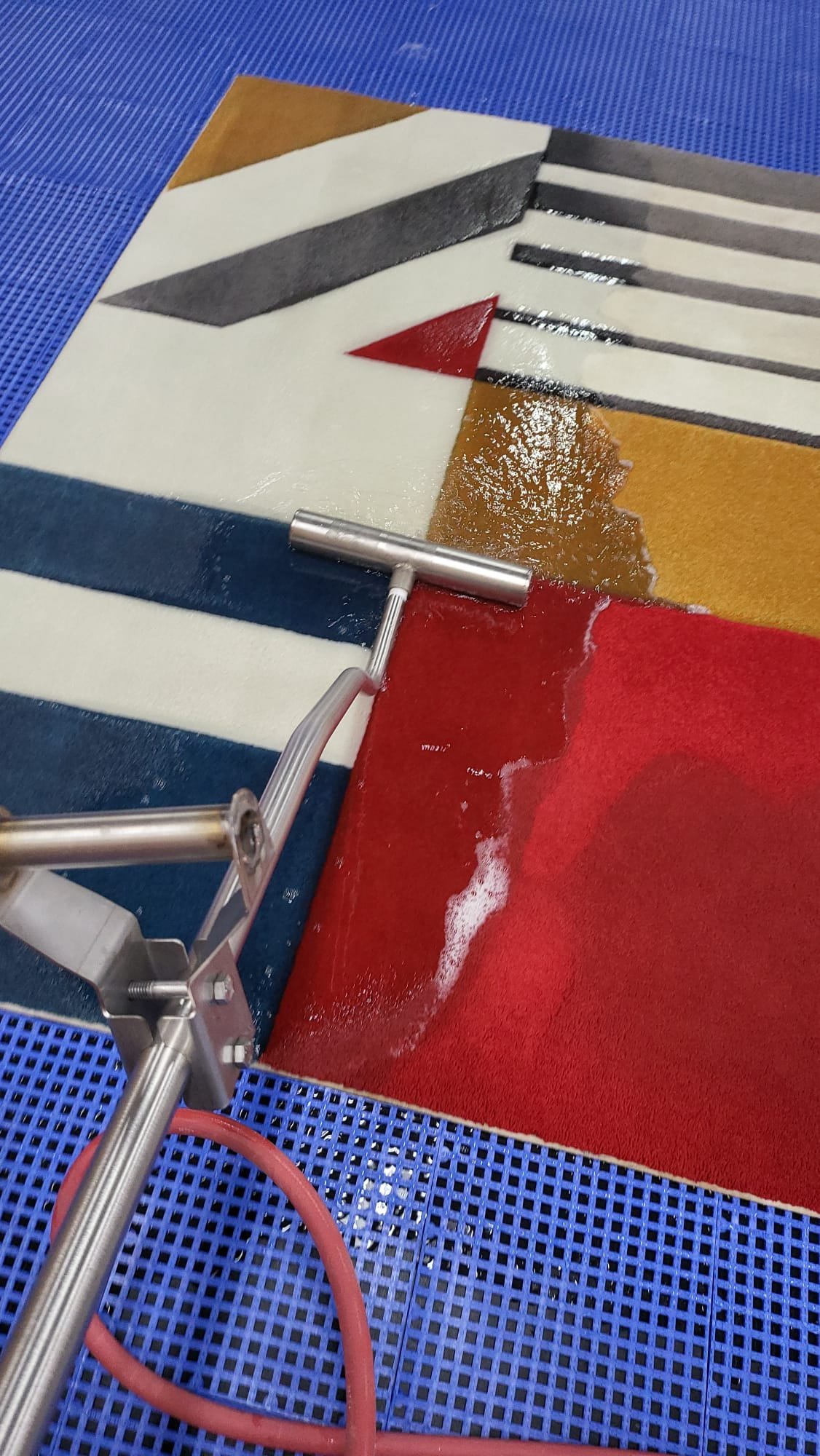
- A full wash — the wash and drying process kills eggs and larvae that surface treatments and vacuuming can miss
- Inspecting adjacent rugs and furniture — moths spread between nearby textiles, so an isolated rug treatment can miss the source
- Moth-proofing treatment — a topical treatment applied after cleaning that discourages re-infestation
- Rotating and airing out rugs periodically — light and movement are natural deterrents
Why vacuuming and mothballs alone usually fail
Vacuuming can remove some surface larvae and eggs but rarely reaches the base of a dense pile where they’re often laid. Mothballs work as a repellent in enclosed storage but do very little for an active infestation already established in a rug that’s out on the floor — by the time damage is visible, the fix needs to address what’s already inside the fiber, not just repel future moths.
Tip: If you find moth damage on one rug, check every wool or silk rug and any stored textiles in the same home — infestations rarely stay isolated to a single piece.
A simple inspection routine for stored or low-traffic rugs
Because moth damage takes hold in exactly the rugs that get the least attention, a periodic check is worth building into your routine. Every few months, unroll or lift stored rugs and check the underside as well as the top, since damage often starts there. Look specifically along edges, corners, and any folded sections for the fine webbing or granular debris that signals larval activity, and check nearby textiles — other rugs, wool blankets, fur items — stored in the same space. Catching an infestation at this early stage, before it’s spread across a large area or to nearby items, makes treatment faster and the outcome far more predictable.
Natural deterrents: what actually helps and what doesn’t
Cedar and lavender are commonly recommended as moth deterrents, and there’s some truth to it — cedar oil in particular has mild repellent properties. But it’s worth being realistic about their limits: these are deterrents, not treatments. They may help discourage moths from choosing a particular storage space, but they won’t eliminate an infestation that’s already established, and their effect fades over time as the natural oils lose potency. Treat cedar blocks or sachets as a supplementary layer alongside proper cleaning and storage, not a substitute for either.
What to do the moment you spot damage
If you find bare patches, webbing, or larval debris on a rug, isolate it from other natural-fiber rugs and textiles in the home right away — moths spread between nearby items, and an infested rug left in contact with others increases the chance of it happening. Avoid the instinct to vacuum aggressively or shake the rug out indoors first, since that can scatter eggs and larvae to other areas rather than remove them. The most effective next step is getting the rug to a full wash and moth-proofing treatment as soon as reasonably possible — the wash and drying process is what actually kills eggs and larvae at every stage, something no amount of home vacuuming or spot treatment reliably achieves on its own.
Why timing matters more than severity
A small patch of moth damage caught early and a large infestation both start the same way — a single female moth finding an undisturbed rug. What separates the two outcomes is almost entirely how quickly it’s addressed, not how the infestation began. A rug treated within weeks of the first sign of damage typically needs a standard wash and moth-proofing; one left untreated for months can require more extensive treatment and may carry permanent, unrepairable thin spots. That’s the practical reason to treat any sign of damage as urgent rather than waiting to see if it gets worse.
Frequently asked questions
Can moth-damaged areas be repaired?
Small areas can sometimes be re-woven or patched by a rug repair specialist after treatment; the priority first is stopping active feeding so damage doesn’t spread further.
Do synthetic rugs ever get moth damage?
Rarely on their own — but a synthetic rug blended with wool or sitting against an infested wool rug can still be affected indirectly.
How long does moth-proofing treatment last?
Typically several months to a year depending on the product and household conditions; rugs in storage or low-traffic rooms often benefit from re-treatment periodically.
Is moth damage covered by insurance?
Usually not — it’s typically classified as a maintenance issue rather than a sudden, covered event, though policies vary.
How can I tell moth damage from carpet beetle damage?
Moth larvae tend to leave silky webbing and casings; carpet beetle larvae are small, bristly, and leave shed skins instead. Either way, the fix is similar: full cleaning plus targeted treatment.
Can moths spread from an infested rug to my closet or furniture?
Yes — clothes moths aren’t picky about which natural-fiber item they infest next, which is why nearby wool, silk, or fur items should be inspected once an infestation is found.
Do cedar blocks actually prevent moth damage?
They offer mild repellent properties and can help as a supplementary deterrent, but they don’t eliminate an existing infestation and their effectiveness fades as the natural oils lose potency over time.
Get a Free Quote → (469) 429-RUGS(7847)
Related: rug moth treatment & prevention · climate-controlled rug storage · wool rug cleaning