
Before any rug goes into our wash floor in Dallas, it gets swept with a UV blacklight in a dark room — and what glows decides how that rug gets cleaned.
The blacklight pass looks like theater the first time you see it. It isn’t. It’s the single step that decides whether a rug with an old pet accident comes out fresh — or comes out worse than it went in, with odor everywhere and dye bleeding through the field. Here’s the actual chemistry behind it, and why “just wash it” is the one thing a professional rug plant will never do to a contaminated rug.
Quick answer: Dried urine leaves fluorescent salt deposits that only show under UV light. Those salts dissolve in wash water and spread through the entire rug, and their high alkalinity chemically loosens the dyes in wool and silk. So contamination gets located under blacklight and treated first — dissolved, neutralized, and flushed out — before the rug ever sees a full wash.
What the blacklight actually shows
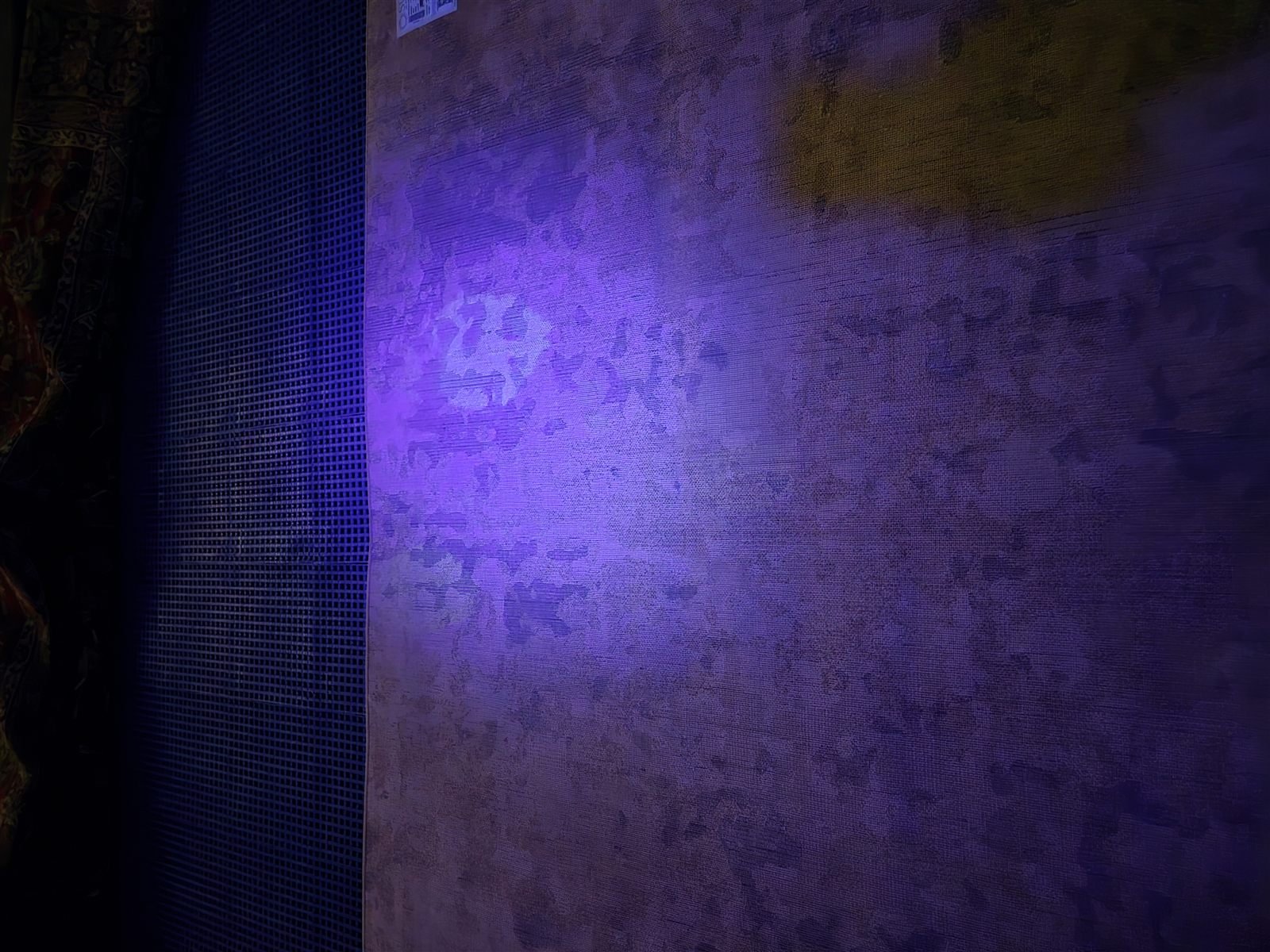
Urine starts out as mostly water, urea, and dissolved salts. As it dries in a rug, two things happen: bacteria break the urea down into ammonia, and the uric acid crystallizes into urate salts that lock themselves around the fibers, down in the pile and into the cotton foundation. Those crystals — along with phosphorus compounds in the residue — are fluorescent: they absorb invisible UV-A light and re-emit it as a visible pale glow. Daylight shows you nothing. Under a blacklight in a dark room, every dried accident on the rug lights up like a map, including ones the owner never knew about.
Why washing an untreated rug contaminates the whole thing
Urate salts have two properties that make them dangerous in a wash: they’re highly water-soluble, and they’re hygroscopic — they pull moisture out of the air. Put an untreated rug into a wash bath and the concentrated deposits dissolve instantly. The bath is now a dilute urine solution, and the whole rug is soaking in it.
Then physics finishes the job. As the rug dries, water migrates outward through the pile and evaporates at the surface — and it carries the dissolved salts with it, re-depositing them everywhere: across the field, through the foundation, into the fringe. A one-square-foot accident becomes whole-rug contamination. And because the salts stay hygroscopic after drying, every humid day — and Dallas has plenty — they grab moisture from the air and release ammonia again. That’s the “the smell came back” phenomenon, and it’s not a cleaning failure. It’s what happens when urine is washed instead of removed.
Dye migration: how urine unsets the dyes in wool and silk
The odor problem is the mild outcome. The expensive one is what urine does to dyes on natural-fiber rugs.
Wool and silk are colored with acid dyes, and the name is literal: the dye bonds to the fiber ionically. In the acid pH range, the fiber’s amine groups carry a positive charge that grips the dye molecule’s negatively charged groups. That grip is what “colorfast” means on a hand-knotted rug — and it is only stable while the pH stays low.
Dried urine is the opposite of low pH. The urea-to-ammonia breakdown pushes the contaminated zone strongly alkaline — pH 10 to 12. That alkalinity strips the positive charge off the fiber, and the ionic bond holding the dye simply lets go. The dye is chemically unset while still sitting in place. The rug looks perfectly fine dry. Then wash water, agitation, and warmth hit that zone — and the loosened dyes dissolve and migrate. Reds and blues bleed into the ivory field, and that migration is usually permanent. The same alkalinity also swells and opens wool’s scale structure (wool is happiest around pH 4.5–7) and degrades silk outright — this is close cousin to the fiber chemistry we covered in wool vs. silk rug cleaning.
The treat-first protocol
All of that is why the order of operations is non-negotiable at a real rug plant:
- Locate under UV. Every rug gets the blacklight pass so nothing dissolves into the bath as a surprise.
- Treat before washing. Contaminated zones get an enzyme and acid-side treatment that dissolves and neutralizes the urate crystals — the acid rinse also re-protonates the fiber, re-setting the dyes and pulling the pH back into the safe range before water and agitation ever touch the rug.
- Flush the salts out. Treating isn’t enough — the dissolved salts have to physically leave the rug, or they re-crystallize as it dries.
- Then the full wash. Only after the contamination is out does the rug get its normal immersion wash — you can see the whole sequence on our cleaning process page.
Skipping straight to the wash isn’t faster. It converts a treatable local problem into whole-rug odor and, on wool or silk, permanent color damage.
Why this matters extra in Dallas homes
North Texas humidity is the accelerant. Hygroscopic urine salts re-activate on every muggy day, which is why an untreated rug can smell fine all winter and turn sour in a Dallas August. And because so many rugs here live over slab floors with pets in the house, old accidents are common even in rugs that look immaculate — we find them under the blacklight on rugs whose owners were sure there was nothing there. If a rug in your home has ever hosted a pet, assume the map has something on it, and have it treated properly rather than surface-cleaned.
Frequently asked questions
Why do you use a blacklight instead of just smelling or looking for stains?
Dried urine is often invisible and nearly odorless in dry, cool conditions. The urate salts it leaves behind fluoresce under UV-A light, so the blacklight shows the true extent and location of contamination — including old accidents the owner never knew happened.
Can’t you just wash the urine out with a stronger cleaner?
No — washing an untreated rug dissolves the urine salts into the wash water and spreads them through the entire rug, where they re-deposit as it dries. The salts have to be dissolved, neutralized, and flushed out in a dedicated treatment step before the general wash.
Why does pet urine make rug dyes run?
Wool and silk use acid dyes, which stay bonded to the fiber only at low pH. Dried urine turns strongly alkaline as its urea breaks down into ammonia, and that alkalinity releases the dye-fiber bond. The colors stay in place while dry, then migrate the moment the rug is wetted — which is why untreated urine zones bleed in a wash.
Why does the urine smell come back on humid days?
Urine salts are hygroscopic — they absorb moisture from the air. On humid Dallas days they reactivate and release ammonia again. If the smell returns with the weather, the salts are still in the rug, and a surface cleaning didn’t remove them.
Does every rug get the blacklight inspection?
Yes — every rug that comes into our facility gets a UV pass before washing, whether or not the owner reports accidents. It protects the rug, and it protects every other rug that shares the wash floor.
Is urine treatment extra, and how do I know if my rug needs it?
Treatment is priced by what the blacklight actually shows, and we photograph the UV inspection so you can see exactly what we found. See how rug cleaning is priced, or send us a photo and we’ll tell you what we’d expect.
Get a Free Quote → (469) 429-RUGS(7847)
Related: pet stain & urine removal · our cleaning process · wool vs. silk rug cleaning