
A hand-knotted Oriental or Persian rug isn’t just more valuable than an average area rug — it’s also chemically different, and cleaning it like a modern machine-made rug can permanently bleed its colors.
Natural dyes have been used in hand-knotted rugs for centuries, prized for their depth and the way they age. That same quality makes them far less predictable under water and cleaning agents than the synthetic dyes used in most modern rugs.
Quick answer: Natural, plant- and insect-based dyes (like madder root red or indigo blue) are generally less wash-fast than modern synthetic dyes, meaning they’re more prone to bleeding or fading if the wrong water temperature, pH, or agitation is used. Every hand-knotted rug should have its dyes tested for stability in an inconspicuous spot before any full wash — this single step is what prevents color bleed.
What makes natural dyes different

Traditional Oriental and Persian rugs are often dyed with plant, root, and sometimes insect-based dyes — madder root for reds, indigo for blues, walnut husks for browns, and cochineal insects for certain deep reds and pinks. These dyes bond to wool fibers differently than modern synthetic dyes, and their colorfastness can vary rug to rug depending on the exact dye lot, mordant (the fixing agent used to help dye bond to fiber), and age. A rug that’s 40 years old with natural dyes may need entirely different handling than a similar-looking rug made last year with synthetic dyes.
Synthetic dyes in modern reproductions
Not every Oriental-style or Persian-pattern rug on the market today uses natural dyes — many modern reproductions, even hand-knotted ones, use synthetic dyes that are considerably more wash-fast and predictable. This is actually good news for cleaning, but it also means fiber and dye identification can’t be assumed from the pattern or country of origin alone. A rug that looks like a century-old Persian design might be a recent reproduction with stable synthetic dyes, or it might be the real thing with natural dyes that need much more careful handling — which is exactly why testing happens on every rug rather than relying on appearance or the seller’s description.
Why dye testing has to happen before, not during, a wash
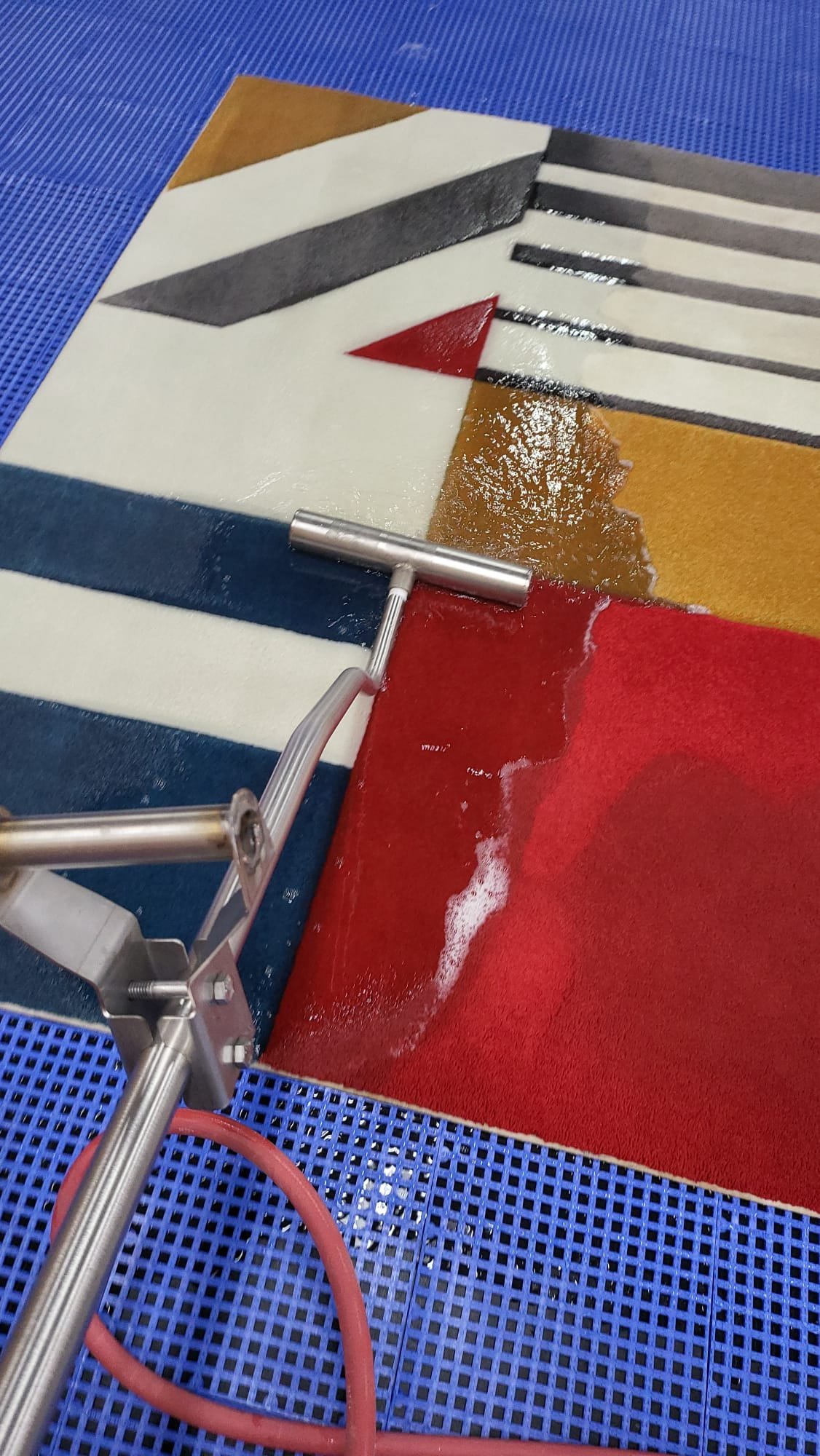
Dye bleed happens fast and is largely irreversible once it’s spread into adjacent colors. Testing a small, hidden area of the rug with the intended cleaning solution — and checking for any color transfer — before committing to a full wash is the only reliable way to know whether a rug’s dyes are stable enough for standard washing, or need a more conservative, low-moisture approach.
- Every color in the rug is tested individually where possible, not just one representative spot
- Water temperature and pH are adjusted based on results, not assumed
- Any unstable colors are noted and the wash approach is adjusted before the rug is fully wetted
Other risk factors specific to antique and hand-knotted rugs
- Foundation age — older cotton or wool foundations can be more fragile and need gentler handling during washing and drying
- Prior repairs — re-wefted or patched areas may use different materials or dyes that react differently than the original rug
- Fringe condition — hand-tied fringe often needs separate, careful attention rather than machine handling
- Uneven prior wear — inconsistent pile height from decades of use can affect how evenly a rug dries
How color run is corrected if it happens
Even with careful testing, some degree of minor bleed can occasionally occur on rugs with genuinely unstable dyes — usually caught early during a controlled wash rather than after the fact. When it happens during a professional process, immediate intervention (isolating the affected area, adjusting water and extraction) can often limit or fully stop the spread before it sets. This is a meaningful reason not to attempt washing a valuable antique rug at home or send it through a general carpet cleaner without dye testing — there, bleed typically isn’t caught until the rug is already dry and the color has fully set into adjacent fibers, at which point correction becomes far more difficult and sometimes impossible.
Why this isn’t a job for general carpet cleaners
A general carpet cleaning company’s standard process — often a single all-purpose solution and machine agitation — isn’t built around dye testing or fiber-specific handling. For a hand-knotted rug with real age and value, that’s a meaningful risk. It’s also why an in-home approach is especially limited here: there’s no practical way to safely flood-rinse an untested antique rug on your living room floor.
Tip: If you’re not sure whether your rug’s dyes are natural or synthetic, don’t assume — a light color transfer test before any cleaning is inexpensive insurance against permanent bleeding.
The economics of getting this wrong
It’s worth being direct about what’s at stake financially. A genuine hand-knotted Oriental or Persian rug with natural dyes can be worth anywhere from several thousand to tens of thousands of dollars depending on age, origin, size, and craftsmanship. Permanent dye bleed or fiber damage from an improper cleaning doesn’t just look bad — it can meaningfully reduce that value, sometimes by a significant percentage, and in severe cases essentially destroy what made the piece valuable in the first place. Set against that risk, the extra time a proper dye-testing process takes before washing is a small, inexpensive safeguard — which is exactly why it isn’t optional for rugs in this category, regardless of how routine the rest of the cleaning process might otherwise be.
How we document the testing process
For higher-value and antique pieces, documentation matters almost as much as the testing itself. Before any wash begins, we record the rug’s fiber and dye findings, note any areas of concern or prior repair, and photograph the rug’s condition. That record protects both the rug and the customer — it establishes exactly what was known and planned for before cleaning began, and gives a clear baseline to compare against afterward. For insured or particularly valuable pieces, this kind of documentation is also often useful to have on file independent of any cleaning need.
How aging affects even stable synthetic dyes
It’s worth noting that synthetic dyes aren’t entirely risk-free over the long run either — while they’re far more wash-fast than natural dyes when new, decades of UV exposure, prior harsh cleanings, or low-quality dye lots in older synthetic-dye rugs can still leave some colors more fragile than a fresh stability test would suggest on a brand-new rug. That’s part of why testing happens on the actual rug in front of us rather than by category — a 30-year-old rug with synthetic dyes and a lot of sun exposure sometimes needs nearly the same caution as a natural-dye piece, even though the dye chemistry itself started out more stable.
Frequently asked questions
How can I tell if my rug has natural or synthetic dyes?
Age is a strong clue — rugs made before the mid-20th century are more likely to use natural dyes — but the only reliable way to know for a specific rug is a professional dye test before cleaning.
What happens if dye bleed occurs during cleaning?
It depends on severity — minor bleed can sometimes be corrected during the wash with immediate intervention, but significant bleed into light-colored areas can be difficult or impossible to fully reverse, which is exactly why testing beforehand matters.
Are Persian and Oriental rugs cleaned differently from each other?
Not fundamentally — both are typically hand-knotted with natural fibers and often natural dyes, so the same fiber-identification and dye-testing approach applies to both.
Does cleaning affect an antique rug’s value?
Proper, fiber-matched cleaning generally protects value by removing damaging soil and stabilizing the rug; improper cleaning (bleeding, shrinkage, fiber damage) is what actually harms value.
Is a machine-made Persian-pattern rug the same risk as a hand-knotted one?
Usually not — machine-made reproductions almost always use stable synthetic dyes, though they still deserve a quick stability check rather than an assumption either way.
How often should a valuable antique rug be professionally cleaned?
Similar to other rugs — roughly every 12 to 18 months for typical use — but always by a facility that dye-tests first, since the consequences of a mismatched process are higher on a valuable piece.
Do you document condition and dye testing on valuable rugs?
Yes — for antique and higher-value pieces, we record fiber and dye findings and photograph condition before cleaning begins, which is useful both for the cleaning process and for the customer’s own records.
Get a Free Quote → (469) 429-RUGS(7847)
Related: Oriental rug cleaning · Persian rug cleaning · antique & heirloom rug cleaning