
If you live anywhere in the DFW Metroplex, your rug is fighting a kind of dirt most of the country doesn’t deal with — fine, reddish clay dust that regular vacuuming simply can’t remove.
North Texas sits on Blackland Prairie and Eagle Ford clay soils that turn to a powder-fine, gritty dust every dry season and track inside on shoes, paws, and open windows. It’s a different problem than ordinary household dust, and it needs a different answer.
Quick answer: DFW’s clay-soil dust is fine, mineral-heavy, and abrasive — it settles at the base of rug fibers rather than sitting on the surface, where normal vacuuming can’t reach it. Left in place, it acts like sandpaper every time the rug is walked on, dulling color and wearing down fibers faster than soil in most other regions.
Why DFW dust is harder on rugs than typical household dirt
Regular household dust is a mix of skin cells, fabric fibers, and light debris — mostly lightweight and mostly sitting on top of the pile. Dallas–Fort Worth’s native clay soil is different: it’s fine-grained, mineral-dense, and genuinely abrasive at a microscopic level. When it’s dry, wind and foot traffic turn it into a powder that works its way past the tips of the fibers and settles at the base of the pile, right where the rug backing meets the yarn.
- Fine enough to bypass surface vacuuming almost entirely
- Mineral content makes it abrasive against fiber under foot traffic
- Settles at the base of the pile, not the surface
- Mixes with humidity swings common in North Texas to bind more stubbornly to fibers
How DFW compares to other regions
Rugs in coastal or consistently humid climates face a different set of challenges — mildew and salt air being common concerns — but rarely deal with this volume of fine, abrasive mineral dust. Rugs in the arid Southwest see plenty of dust too, but North Texas’ clay content specifically makes ours denser and more prone to binding with moisture during our humid summer months, effectively cementing itself deeper into the pile than drier, sandier dust would. That combination — clay content plus humidity swings — is fairly specific to the Blackland Prairie region DFW sits on, which is part of why generic, national cleaning advice tends to underestimate how often local rugs need a real deep wash.
What it actually does to a rug over time
The damage is mechanical, not chemical, which is why it’s easy to miss until it’s advanced. Every time the rug is stepped on, trapped grit grinds against the base of the fibers like fine sandpaper. Over months, that shows up as:
- Dulling and graying of color, especially in traffic lanes
- Fibers that feel flattened, brittle, or thinner than the rest of the rug
- A grayish “halo” visible when the pile is parted
- Faster wear-through in high-traffic areas than the rug’s fiber quality would predict
- A change in how light reflects off the rug — clean fibers reflect light evenly, while dust-coated fibers scatter it, making even an expensive rug look visually cheap
Why vacuuming alone doesn’t fix it
A vacuum, even a good one, mostly agitates and lifts debris sitting on or near the surface. Clay dust that has worked its way to the base of a dense wool or hand-knotted rug largely stays put — vacuum suction isn’t strong enough at that depth, and aggressive beater-bar agitation on a delicate rug risks damaging the fibers before it dislodges the soil anyway. Even daily vacuuming, done perfectly, is addressing maybe the top third of what’s actually trapped in a well-used rug.
What actually gets it out
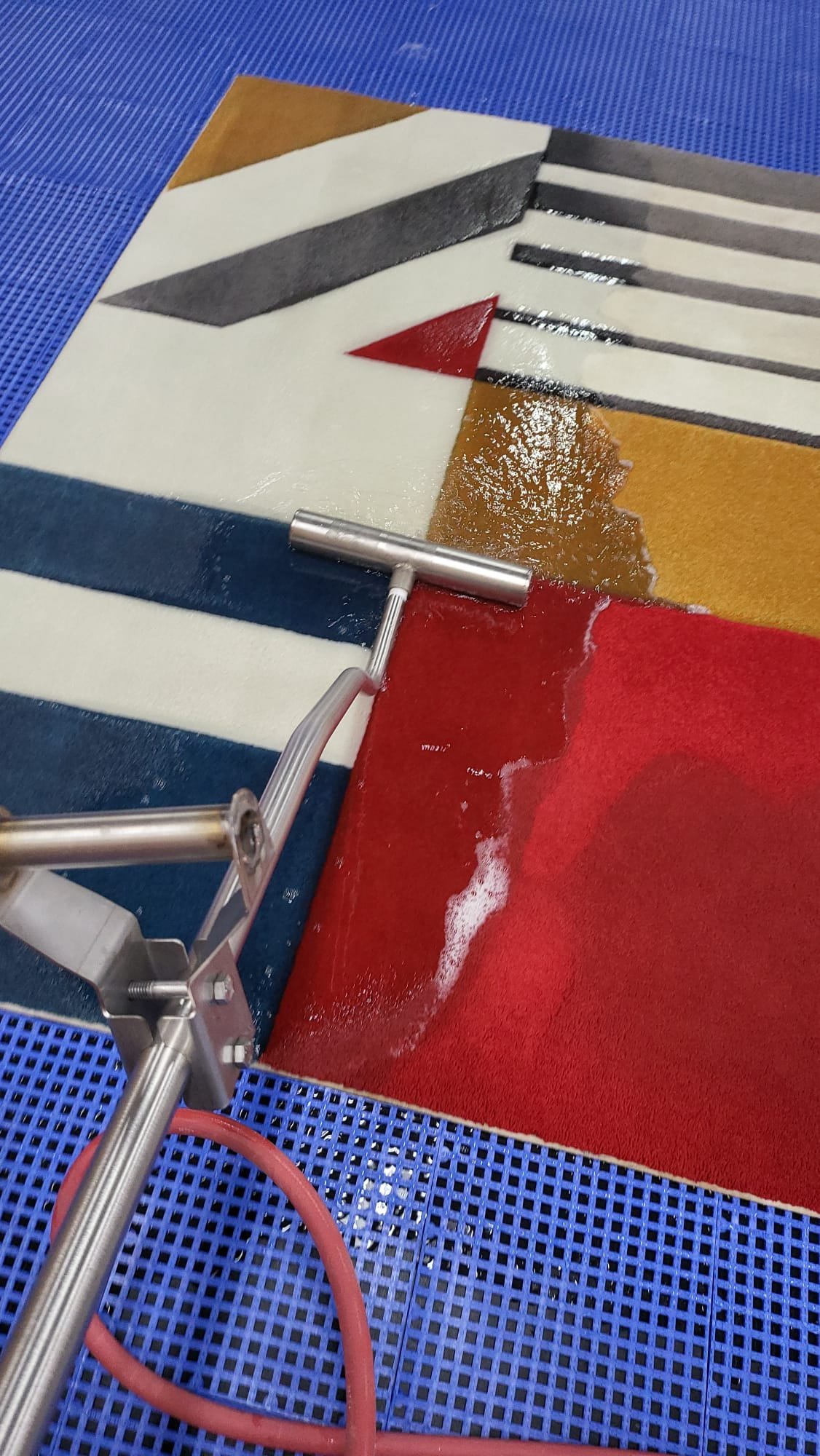
Clearing dust from the base of the pile takes two steps most in-home cleanings skip entirely: a dry, mechanized dusting process that vibrates embedded grit out before any water is introduced, followed by a full-immersion wash that flushes the foundation of the rug, not just the surface. That combination is the difference between a rug that looks clean and one that’s actually had the abrasive material removed. Dry dusting alone can remove several pounds of grit from an average area rug — weight that was previously sitting silently in the base of the pile, working against the fibers with every step.
Practical ways to slow the buildup between cleanings
- Entry mats at every door — the single biggest lever, since most clay dust enters on shoes
- A no-shoes policy in rooms with valuable or delicate rugs
- Regular HVAC filter changes — a dirty filter recirculates more airborne dust throughout the home, including onto rugs
- Vacuuming both sides of the rug periodically, not just the top
- Rotating rugs so dust and wear don’t concentrate in the same traffic lanes indefinitely
Tip: If your rug feels noticeably lighter or “fluffier” right after a proper facility cleaning, that’s usually the clay dust that’s been sitting in the base of the pile finally gone.
Seasonal patterns worth knowing
Clay dust exposure isn’t constant year-round in DFW — it tracks with the region’s weather cycles. Late summer and fall, when the ground has dried out after the wetter spring months and wind picks up, tend to bring the heaviest dust loads. Early spring, right as things dry out after winter moisture, is a second smaller peak. Rugs near frequently-opened doors or windows, or in homes bordering undeveloped land where the native soil is more exposed, tend to see this pattern most strongly. Knowing your household’s pattern can help you time a deeper interim vacuum or an earlier professional cleaning around the worst stretches rather than sticking to a flat calendar date regardless of season.
How this affects rug value over time, not just appearance
Beyond the visible dulling, sustained abrasive wear has a real effect on a rug’s long-term value and lifespan, especially for wool and hand-knotted pieces. Fiber that’s been thinned by years of embedded grit doesn’t just look worse — it’s measurably weaker, more prone to further wear, and harder to fully restore even with proper cleaning once the damage has progressed far enough. For anyone holding a rug as a long-term investment, whether family heirloom or a quality purchase meant to last decades, staying ahead of clay-dust buildup with regular deep cleaning is directly tied to protecting that value.
How professional dusting equipment differs from a home vacuum
The gap between a household vacuum and facility dry-dusting equipment is bigger than most people expect. A vacuum relies on suction pulling air through the pile from one direction, which mostly agitates the top layer. Facility dusting equipment instead uses controlled mechanical tamping or vibration from multiple angles, working the rug the way you’d shake dust out of a heavy blanket rather than skim it with a hose. That mechanical action reaches grit sitting at the base of the pile that suction alone can’t dislodge, which is why a rug can go through a thorough home vacuuming routine for years and still release a visible cloud of fine clay dust the first time it goes through proper dry dusting.
Frequently asked questions
Why does my rug get dusty again so fast in North Texas?
Clay soil dust is fine enough to become airborne easily and re-settles quickly, especially during dry, windy stretches. It’s a regional issue, not a sign your rug is unusually dirty.
Does a doormat actually help?
Yes — a quality doormat at every entrance meaningfully cuts down how much clay dust makes it onto interior rugs, though it won’t eliminate it entirely.
How often should DFW homes clean rugs because of this?
More often than the national average in most cases — every 6 to 12 months for high-traffic rugs, rather than the 12 to 18 month rule of thumb for milder climates.
Can this dust damage synthetic rugs too?
Less than natural fibers, but yes — synthetic pile can still show premature crushing and dulling from embedded grit, just at a slower rate than wool or silk.
Is this dust the same as what settles on furniture and floors?
It’s the same source material, but rugs hold onto it differently — hard floors let dust be wiped or swept away easily, while rug fibers trap and hold it until it’s flushed out with water.
Does dry dusting alone solve the problem without a full wash?
No — dry dusting removes loose, dry grit, but soil that’s already bonded to fibers through humidity or oils needs a water-based wash to fully release.
Is clay dust worse in certain DFW neighborhoods than others?
Homes near undeveloped land, construction, or with frequently-opened doors and windows tend to see heavier dust exposure, though the underlying soil type is consistent across most of the Blackland Prairie region.
Get a Free Quote → (469) 429-RUGS(7847)
Related: professional rug cleaning · our facility · DFW service areas