
Most area rugs should be professionally cleaned every 12 to 18 months — but pets, kids, allergies, and foot traffic can change that a lot. Here’s how to know what’s right for your home.
Your area rugs quietly trap more than they show — dust, dander, pollen, and gritty soil settle deep into the base of the fibers where a vacuum can’t reach. Cleaning on the right schedule protects both how your rug looks and how long it lasts. Here’s a simple guide to how often your rugs really need professional attention, straight from a facility that washes rugs full-time in the DFW Metroplex.
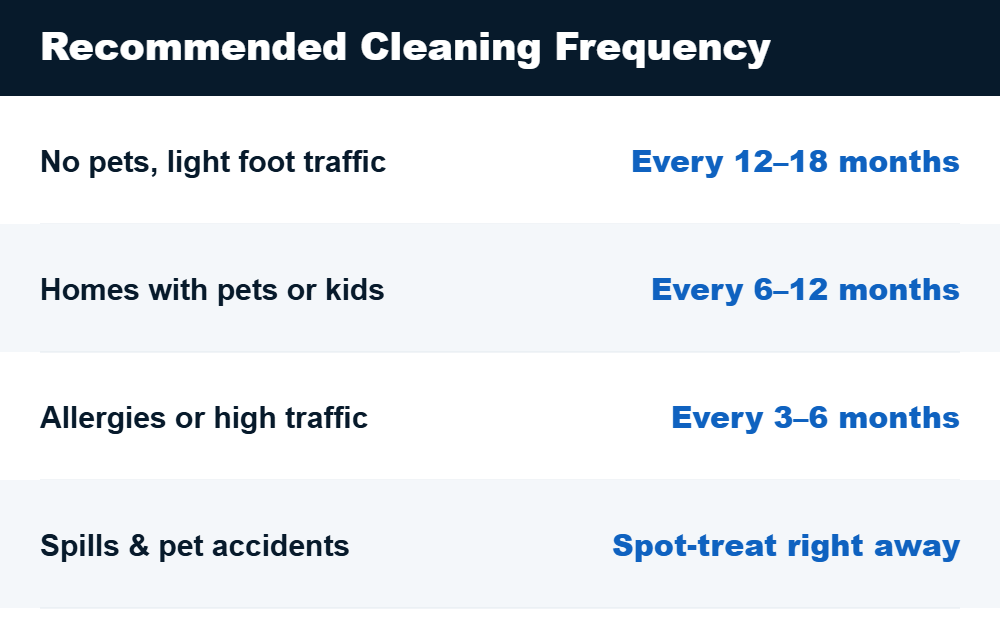
Quick answer: Clean an average household rug every 12–18 months. Homes with pets or kids need it every 6–12 months. Allergy-sensitive households should clean every 3–6 months. Spills get spot-treated immediately, regardless of schedule.
The simple rule of thumb
For an average household, plan on a professional deep cleaning every 12 to 18 months. That keeps embedded grit from wearing down the fibers and removes the allergens a vacuum leaves behind. From there, adjust up or down based on your home.
What changes how often you should clean
A few factors push that timeline shorter:
- Pets. Dander, hair, and the occasional accident mean more frequent cleaning — usually every 6 to 12 months.
- Kids. Spills, snacks, and floor play add up fast.
- Foot traffic. Entryways, hallways, and living-room rugs collect far more soil than a guest-room rug.
- Allergies or asthma. Cleaning every 3 to 6 months keeps trapped allergens down.
- Delicate fibers. Silk, wool, and viscose benefit from gentle, regular care.
How DFW’s climate affects your rug’s cleaning schedule
North Texas adds a factor most national cleaning guides don’t account for: fine, mineral-heavy clay-soil dust that blows in during dry spells and settles at the base of rug fibers, not just the surface. That means a rug in a Dallas–Fort Worth home is generally accumulating abrasive, deep-set soil faster than the same rug would in a milder, less dusty climate. Combine that with our long, humid summers — which give any trapped soil, pet dander, or moisture more time to interact with the fibers — and it’s common for DFW households to need cleaning on the shorter end of every range above, even without pets or kids in the picture.
Signs your rug is overdue
- It looks dull or feels stiff underfoot. Embedded soil coats individual fibers, scattering light instead of reflecting it cleanly, which is why a dirty rug looks visually flat even when it isn’t stained.
- A puff of dust rises when you pat it. That’s dry soil sitting loose in the base of the pile — a strong sign the deep layers haven’t been cleared in a while.
- Lingering pet or musty odor. Odor that doesn’t fade after airing out the room usually means the source is inside the rug, not just in the air.
- Traffic lanes look darker than the edges. This is soil, not just wear — the fibers along walking paths are collecting and holding more grit than the protected edges.
- Static or a slightly sticky feel. A buildup of oils and residue from skin contact, pets, and airborne grease (common near kitchens) changes how the fiber feels before it changes how it looks.
Tip: Vacuuming helps, but it only lifts surface debris. The grit that actually grinds down fibers lives at the base of the pile — and that only comes out with a full-immersion wash.
Why professional cleaning beats DIY
Rental machines and in-home services clean the surface, but they can’t safely flush the foundation of a rug — and over-wetting wool, silk, or viscose at home risks shrinkage, browning, and dye bleed. A rug cleaned in place also stays damp far longer than one dried in a controlled facility environment, which is exactly the window mildew and odor-causing bacteria need to take hold. We pick your rug up, dust out the dry soil, hand-wash it in a facility built for rugs, dry it in a controlled environment, and deliver it back fresh. See how our facility works.
What happens if you wait too long
Delaying a cleaning past the recommended window doesn’t just mean a dirtier-looking rug — it changes the type of work the rug eventually needs. Soil trapped at the base of the pile is abrasive, and every footstep grinds it against the fiber like fine sandpaper. Left unaddressed for years, that abrasion thins and weakens fibers permanently, and no cleaning afterward can restore fiber that’s already been worn away. In practical terms: a rug cleaned on schedule usually just needs a standard wash, while a badly neglected rug may need additional treatments — deep deodorizing, color correction for soil-dulled dye, or even repair — that cost more than routine maintenance would have.
How to stretch the time between cleanings
- Vacuum regularly, gently, on both sides.
- Rotate the rug every few months so wear stays even.
- Blot spills immediately — never rub.
- Use a quality rug pad to cut friction and protect your floor.
- Place a doormat at entry points to cut down how much outdoor grit — including DFW’s clay dust — makes it onto the rug in the first place.
What a professional cleaning actually involves
It helps to know what you’re scheduling. A real professional cleaning isn’t a single step — it typically starts with an inspection and fiber test, moves into dry dusting to vibrate loose grit out of the base of the pile, then a full-immersion wash matched to the rug’s fiber, thorough rinsing to clear all cleaning residue, water extraction, and finally controlled drying followed by grooming and a quality check. Each of those steps addresses something a lighter, faster service skips. Dry dusting alone, for example, can remove several pounds of dry soil from an average area rug before a drop of water is ever used — soil that would otherwise just get pushed deeper into the pile by a quick surface wash.
Building a simple household reminder system
Because rug cleaning happens on a longer cycle than most home maintenance, it’s easy to lose track of when a rug was last done. A simple fix: note the cleaning date somewhere you’ll actually see it again — a recurring calendar reminder, a note in your phone, or even a small tag tucked into the rug’s edge. Pair that reminder with your household’s specific interval from the table above (12–18 months as a baseline, shorter with pets, kids, or allergies) and you’ll rarely find yourself guessing whether a rug is overdue. This matters more than it sounds like it should — the single most common reason rugs go years between cleanings isn’t cost or inconvenience, it’s simply that nobody was tracking the date.
Timing a cleaning around a move, renovation, or event
Beyond the regular interval, a few specific moments are worth scheduling a cleaning around even if it’s early. Before a move into a new home, a fresh wash means you’re not laying down a rug that’s carrying years of the previous house’s soil and allergens. After a renovation, construction dust — drywall particles, sawdust, fine debris tracked in on work boots — settles into rugs left in or near the work area even under plastic sheeting, and that dust behaves similarly to DFW’s clay-soil dust in how deeply it embeds. And before hosting a larger event, a cleaning restores color and texture in a way that’s noticeable in person even if the rug wasn’t visibly dirty. None of these replace the regular schedule, but they’re reasonable exceptions worth building in when the timing lines up.
Frequently asked questions
How often should I clean my rug if I have pets?
Every 6 to 12 months for most homes with pets — sooner if there are accidents or odor, which need a full flush-and-treat at the source.
Does vacuuming count as cleaning?
Vacuuming is important maintenance, but it only removes surface debris. Deep soil and allergens at the base of the fibers need a professional wash.
Can cleaning too often damage my rug?
Not when it’s done correctly. Gentle, fiber-matched professional cleaning protects a rug; it’s harsh DIY methods and over-wetting that cause damage.
Do you pick up and deliver?
Yes — free pickup and delivery across the DFW Metroplex, with an upfront price before any work begins.
Should a rarely-used guest room rug still be cleaned on schedule?
Yes, though it can usually go toward the longer end of the range. Low-traffic rugs still accumulate airborne dust and are also at higher risk of moth activity since they’re rarely disturbed.
Is there a difference in schedule for wool versus synthetic rugs?
Not dramatically — soil accumulation depends more on traffic and household factors than fiber type. Fiber matters more for how the rug is cleaned than how often.
What’s the easiest way to remember when a rug is due for cleaning?
A recurring calendar reminder set to your household’s interval — 12 to 18 months for an average home, shorter with pets or allergies — is the simplest way to avoid losing track between cleanings.
Get a Free Quote → (469) 429-RUGS(7847)
Related: professional rug cleaning · what rug cleaning costs · rug pads